

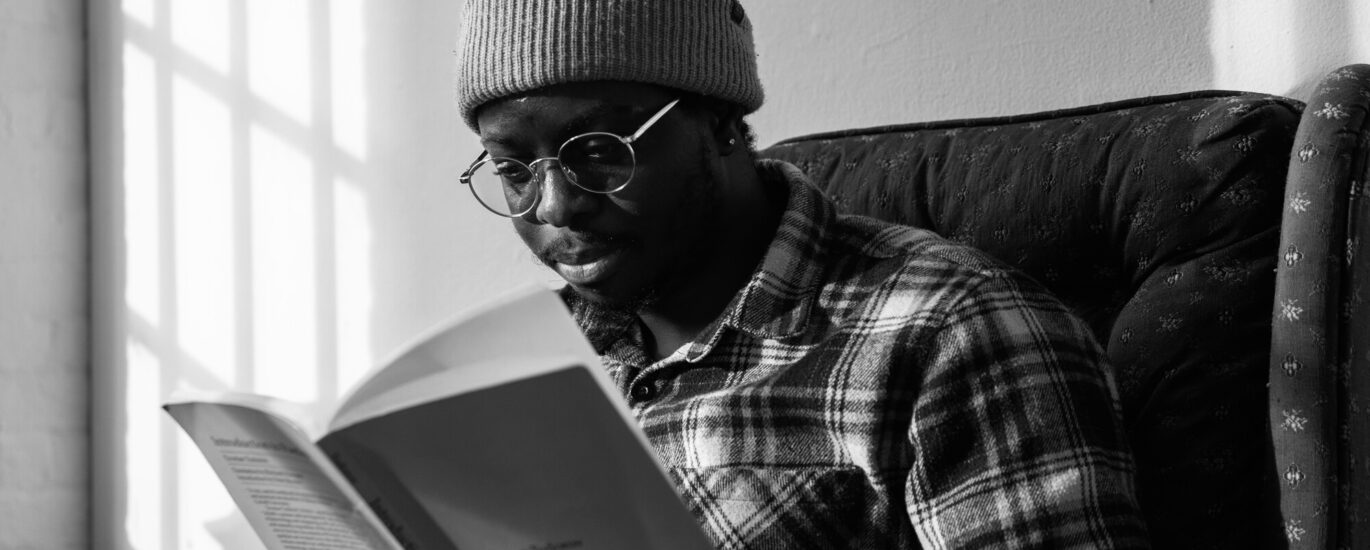
Obindo: Thank you, O-Jeremiah, for taking the time to chat with me. You trained in law at the University of Ibadan before doing an MFA. Have any skills, perspectives, or ways of arguing from your legal education shown up unexpectedly in your poems?
O-Jeremiah Agbaakin: In the past, I have been quick to say NO. It will amuse you to know that one of the reasons why I became a poet was because I did not want to be a lawyer. Much of that thought process has to do with the adversarial nature of law and legal practice in Nigeria. We were constantly informed that language is the business of the lawyer. The idea that language is a business, a tool to be weaponized in the arena of a conflict did not sit well with me. Although we were introduced to other methods of dispute resolution such as the inquisitorial method popular in civil law jurisdictions like Austria, France, Netherlands, and some Latin American countries, where the judge can wade into the dispute unlike in common law jurisdictions like Nigeria (and even, broadly speaking, alternative dispute resolution options) my orientation on a successful legal practice in Nigeria was a temperament agreeable with drawn-out conflicts and the cheapening of language to a weapon to be wielded. I wanted language to be an experience for me. I wanted to live in language and pursue a life and career that allowed me to do that.
Looking back, I think one moment during my legal education that has definitely shaped my approach to poetry was in my 400-level or final year where we took a Jurisprudence course. It was my favorite course because it was not about law but the philosophies of law. My favorite topic being, ironically, Hegelian Dialectics. Ironically because dialectics is essentially about conflict and the formation of new theories through the opposition of ideas. In my poetry, this is also my impulse. How can we escape the dogmas of practical language? How can language transcend its own prison? How can we render our emotions and the collective experience of the universe with a new language that is simultaneously also its own artistic experience. It is almost as George Eliot says that to be a poet is to have a soul “so quick to discern, that no shade of quality escapes it, and so quick to feel, that discernment is but a hand playing with finely-ordered variety on the chords of emotion–a soul in which knowledge passes instantaneously into feeling, and feeling flashes back as a new organ of knowledge.”
This in addition to a “Latin for Lawyers” course made my interest in language beyond a business tool stronger. Poetry was an outlet to pursue that. Yet, my training in law and in those classes sensitized me to the idea that language can be transcendental in its own self-contradictory, agonistic mode. My point of departure is that I want the inner contradictions of language and their dialectical resolution to be an experience for me, not a business triumph. I will also add that I have benefited from the lawyerly emphasis on precision of language in my own practice as a writer. It has trained me to look for the best image and to be comfortable in a narrative tension. Lastly, I will say that the rigor of a legal training has shown up in the rigor of my own revision practice. I guess we will never find out if I would still have those qualities without a legal background.
Obindo: In your works like “a thesis on language (abstract)” you weave biblical references through the poem — John 1, Genesis 4, Matthew 22 — as linguistic and cultural architectures, but you also infuse the fragility of African oral literary traditions in the lines “this is how we lose memory:/ the words go away first/ in a land where cockcrow is mnemonic for timing” What draws you to scripture as a linguistic archive, and how does recontextualizing it allow you to challenge inherited narratives?
O-Jeremiah Agbaakin: The artist must use what he has. My short answer to that question is in Louis Gluck’s poem, “Nostos” which concludes with such profound lines: “We look at the world once, in childhood. / The rest is memory.” All my writing is looking back at childhood and making sense of the contradictions in the life of a subject that is a product of several forces. The accident of our birth means that most of our creed, stances, ideologies, and persuasions are already set in stone. In a typical Yoruba society evenly split between the church and the mosque, you are either. Although I was raised Christian, most of my extended family members were muslims. I was always struck by the conviction of the other despite the claim in our local church that they worshipped a false God and similarly the reciprocal near-contempt by Muslim families and neighbors. I was often fascinated by my grandmother observing solat inside her food canteen and would try to imitate her out of curiosity. She would get mad whenever we walked in front of her, so she usually put a broom or a physical object to draw a kind of boundary as she communed with her God. I was struck because in the church, they would often refer to non-Christians as unbelievers. How could my grandmother be an unbeliever? How could my non-christian uncles and aunts even satirically refer to my siblings and I as unbelievers as a kind of mockery and even shaming?
Yet, for me, the coin toss yielded an even more interesting third face. It was the religious traditional beliefs. I was struck by the conviction it required to make offerings, prayers, and even transmit a cohesive oral traditional knowledge across generations. In fact, my grandparents’ house which we visited often had a lot of shrines. At the risk of revealing too much, I would imitate the worshippers and sometimes construct a makeshift shrine myself. Not just out of simple mimetic impulses, but an imagination attuned to a resistance of the religious duopoly in my immediate environment. I wanted an imagination that is free of the fear of the unknown, which indigenous religions are usually subjected to. I wanted to be free from fear. But I am also cautious of absolutism. It is possible to be rooted culturally and practice another religion well. But to be rooted in culture, one must seek to understand it.
So my work is a kind of attempt at that understanding. My starting point is what you have described as the scriptural archive. I love your characterization of that, but what gets to be the archive? What is the scripture? Is it disputable? What makes it into the coda, into the canon? My work is an ongoing attempt to undo embodied self-hatred while articulating from a position of cross-cultural interaction, not mutual fear of the other. I admire Dr. Tunde Agboola’s scholarship in that he enlightens a kind of rationalism in investigating cultural knowledge and praxis instead of keeping the tight lid of mysticism on them which further alienates the people from understanding or even embracing it. It is because no culture or religion is perfect (despite contrary claims) that we must seek to understand it, to stand close to it.
Obindo: You’ve spoken about the tension between meaning and obscurity in poetry. Could you walk us through, perhaps, your favourite poem of yours and show how you decide what to reveal and what to keep elusive for the reader?
O-Jeremiah Agbaakin: The fact that poetry exists is proof that we yearn for something beyond words or rationalism. I am not a fan of obscurity for obscurity sake. I have never written a poem where I chafe away at any clarity as the goal. My favorite poems to read are difficult poems that reveal themselves to me without any attempt to understand them or that have initially resisted earlier interpretation. It is cognitively rewarding to exercise technical appraisal of a poem and get as close as to the intention of the writer as possible but without a vicarious exchange of the experience embedded in the poem (I am not even talking about experiencing the same thing as the writer), poetry just feels like any other pleasure that you would feel after completing a run, eating a good food or even good sex. If good poetry was easy to write, then why are we artists? I am a private person, so I use my art to explore subjectivity and personhood. My favorite poem to write is the one where I release just enough information while transcending myself or the experience that led to the poem. That being said, my favorite poem is “Good Friday” published in Guernica not only because of the aforementioned but also because it is a moment in my writing that I felt the most divine and human at the same time. The father in the poem is a divine one and a very human one, autobiographically speaking. It was to demystify figures that we attribute exclusive authority to. I mean in Yoruba and most religions, the father figure is unimpeachable. I find this patriarchal attitude pretentious and harmfully paternalistic because I had experienced it in my own immediate and extended family. It is the reason why I wrote The Sign of the Ram. Moving away from the subjects, I think my favorite poems to write are poems that excel musically for me and that is what “Good Friday” does well. It is a poem that I felt was ready when it felt like a stranger to me because of its mystery but felt close because of its musical resonance and the negotiation of its Yoruba and English idiomatic proposition.
Obindo: You’ve stated that “When you’re in a workshop, sometimes they want (out of good intention) to trace a narrative arc in your poetry, even when the language, technique and form are doing a good job” how important have workshop communities and formal fellowship structures been for your development, and what do you think these spaces get right (or wrong) about nurturing African poets?
O-Jeremiah Agbaakin: The reason why poetry is the least popular genre– whatever yardstick you use – is because it must not tell a story to be and people love stories. My hot take is that many who write those kinds of poems are responding to that need. Having this in mind, I take such feedback with a deep understanding and not take it too personal. All you need is for one person who gets it. That is enough. I think signing up for a workshop already suggests that you are ready to lose any control of your work and what you want it to be to other people. So, it is important to be ready to listen to everybody. At the end of the day, it is still your poem. At the end of the day, we are our own best critics. I will say that it is a privilege to be among other people who care about the craft, if they care, discuss your work. At the end of the day, workshops are just formal structures to receive feedback for ongoing projects. Every writer – African or not– interested in participating must ask themselves whose opinions matter most to them in that kind of space.
Obindo: As a submissions editor and poetry reader for journals, you see countless manuscripts. What recurring habits do you notice in early-career poets that either elevate a submission or cause it to be overlooked? Any practical advice for poets trying to get noticed?
O-Jeremiah Agbaakin: My advice will be similar to the earlier one. Let me say that I try my best not to generalize my observations during my roles as a reflection of the writing directions or trends in the world. There are thousands of journals in the U.S. and Nigeria alone. There are millions of living writers we may never read their work. So, the empirical evidence is limited and to have a strong opinion about the state of writing or the trajectory of writing among early career poets is hubristic at best. I am not saying that you are guilty of this but it is best to leave audacious pronouncements or opinions as this to, let’s say, digital humanities scholarly studies. One of the issues plaguing our digital age is our strong desire to be an authority on a field that we are yet to master. Call it influencer syndrome. So I would preface my answer with this submission.
I should also say that no habits of mind are more important to a serious writer than the rigor of their writing, which is usually self-evidently effortless as Yeats noted in his “Adam’s Curse” that: I said, ‘A line will take us hours maybe; / Yet if it does not seem a moment’s thought, / Our stitching and unstitching has been naught.” My observation about what snakes for publishing success is cliche: persistence and authenticity. Do not write to be popular. Write against the grain and trend. Will you still love this poem after ten years? Will you still be proud of this poem if the pub;isher or journal were to go defunct? I think it is easy to see submissions that do this. There is something about the poem that is uniquely the writer’s. Yet, and sadly so, you can still be rejected after writing poems like this, even for journals that claim to like poetry like that. If I were to advise my younger self, I would say that it is important to care so much about the journal or the editor that you would want them to edit and publish your work.
As an editor, I know that I am taking a risk of accepting a work at the expense of other works. There is no poem that I accepted that I did not think and feel deserving. But there are poems that did not get the cut that were deserving. I think having this perspective can be liberating for the writer who is faced with rejections.
Obindo: You’ve been nominated for Pushcart and Best of the Net, and you’ve been a finalist for a few first-book prizes. How do contests and prizes figure into your practice — as validation, distraction, or a useful part of a poet’s career infrastructure?
All of the above. Poetry and writing is financially rewarding compared to the labor. But it is existentially rewarding. AWARDS and recognition are good but are fleeting. I wrote and recited my first serious poem in 2011 when Uncle Mathew, my secondary school english teacher told us that my school had been invited to perform a poetry to celebrate the environment at Osogbo, the capital city. I and Tobi, my childhood friend and classmate, spent countless hours in his living room writing and rewriting the poem. It has to be perfect. There was not going to be room for a weak image, line or word. I was frustrated by the countless attempts to sculpt the ceremonial poem. At the end of the exercise, the poem was ready, he announced. Ready for the world, that is. I remember the reaction of the audience when a line from the poem warned: “that our unborn children will starve and die” if we don’t take care of the environment. It was a defensive laugh in the face of such an apocalyptic line but the seeds of current writing subjects were sowed on that day. I think you get the drift of my anecdote. The writing was what mattered but it felt good to have an audience react the way they did. It was an affirming response that resonates till today but it is not the reason why I write. I write because I come from a background of writing, because I understand my position in the cosmos. I feel lucky to be able to discover more about the universe and to be closer to it. It feels like a calling.
Obindo: Looking ahead: what formal or thematic territories are you most excited to explore next?
O-Jeremiah Agbaakin: I have been working on a long poem book. The classes that I took with Maggie Zurawski and Andrew Zawacki here in UGA introduced me to excellent book-long poems. The most notable is Alphabet by Inger Christensen. I am currently working on one but it is on pause to focus on my first full length as well as my comprehensive exams. I am also interested in writing autofiction projects. That is fiction that blends elements of autobiography. This is influenced by my immersion in Teju Cole’s fiction, but also my interest in voice, character, and persona in poetry. I am working on a collection of short stories that adopt the autofictional mode.
O-Jeremiah Agbaakin is the author of The Sign of the Ram (Akashic Books, 2023), selected by Kwame Dawes and Chris Abani for the New Generation African Poets Chapbook series. His poems and reviews are published or forthcoming in Poetry Review (UK), Kenyon Review, POETRY Magazine, Poetry Daily, The Rumpus, and elsewhere. He’s received fellowship & support from Georgia Writers Association, Good Hart Artist Residency, Massachusetts Museum of Contemporary Art, Bread Loaf, Tin House; and a Graduate Research Award from the Willson Center for Humanities and Arts, University of Georgia where he is currently a PhD student of Creative Writing and Literature.

No Related Post

