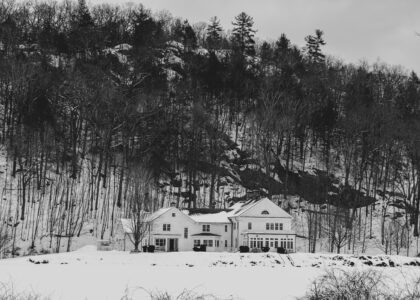
In front of my aunt’s house, I kneeled next to my crying grandfather and placed my hand on top
of his. He was sitting on a lawn chair, his cane resting on his knee.
Behind us was the yellow moving truck my father had rented. It was towing my stepmom’s
red 1995 Pontiac Firebird. Bev, my dad’s second wife, hated Pennsylvania and wanted to move
to Florida.
In the winter of 1997, I was 14, in eighth grade, and had mixed feelings about the move. Part
of me wanted to stay with my friends, whose parents also tended to be separated, and part of me
wanted an adventure, a chance to make new friends, and to photograph a Florida beach.
Because Aunt Kathy was always taking photos, she took a picture of her father, Paul. I had
never seen my grandfather cry.
He was a farmer, who had replaced cornfields with softball fields, so the church he had helped
form could start a softball league. He was an entrepreneur, who had started over 50 businesses
and quickly got bored with most of them. He was a husband, who believed a man’s heart was
through his stomach, but since he didn’t like my grandmother’s cooking, he was always taking
me out to dinner.
After my family’s farewell dinner, we gave our goodbye hugs.
I didn’t cry the day my grandfather did, though I would miss him. He had given me my first
job and a childhood to remember when I was surrounded by moments I mostly wanted to forget.
On the softball fields with my friends, I had found a place to escape the pornography my dad
had accidentally left in the VCR, the extramarital affairs my mother had, and the constant
arguing in a house that was rarely clean.
Close by, my grandparents’ home was just down the street. Between our homes was a tennis
court, because my grandfather loved tennis, an aboveground swimming pool, because someone
gave it to us, and two of the four softball fields.
Our house, which my grandfather also owned, was big, cold during the winter, and poorly
maintained. Since my family had the appearance of wealth, I let my friends believe we were
wealthy, and then I would ask if they wanted to swim or play baseball.
Despite my grandmother’s concerns, when I was seven, I started mowing the ballfields with
an orange, Allis-Chalmers tractor. Since I was too short to reach the brake pedal, I slid down on
the seat. On a red Massey Ferguson tractor, pulling a carpet behind me, I dragged and smoothed
the infield dirt.
After I struggled to lift a 50-pound bag of chalk and place the white powder into a chalk liner,
I failed to walk in a straight line and line the infield properly. Although I should have used string
to guide me, I was lazy, so instead of straight lines, I opted for waves.
In the passenger seat of the yellow moving truck, I waved goodbye to my grandfather. I didn’t
think this would be the last time I would see him. At 84, he seemed relatively healthy, but a
couple of months after we moved to Florida, he took a nap and passed away.
Alone in my new bedroom, I cried and wanted to see him one last time. I kept wanting to tell
him something, but I didn’t know what. Maybe I just wanted to thank him for being in my life,
for all the meals and ice cream he had bought me, especially when we didn’t have much food in
our house, for getting on the red tractor and helping me finish mowing a softball field (it’s still
my favorite moment of us together) and for paying me six dollars an hour to do a subpar job.
With my paycheck, I had bought athletic clothes from Eastbay, socks without holes, and
pasteurized milk, since the cheaper, unpasteurized milk my parents switched to made me sick.
At my grandfather’s house, I leaned over my cousin’s shoulder and tried reading obituaries. It
was an impossible feat because I couldn’t focus. At the Congregational Bible Church, where my
grandmother had played the blind woman Jesus had healed during the Christmas pageant, I
watched my grandfather find peace.
A part of my childhood died with him. I owed him more than he owed me. Never again would
he buy me ice cream, take me out to dinner, and ask me to sneak him a chocolate bar.
Inside the main hall, Uncle Galen gave a sermon. I didn’t know what it was about, because I
wasn’t paying attention. On stage, our family sang songs, which I didn’t want to do. The
grandchildren were forced to read Psalms, which I definitely didn’t want to do.
After the funeral service, my dad turned on his headlights and drove to Bossler Mennonite
Church, a redbrick building with a small gravesite surrounded by farms and silos.
With five other men, I unloaded his casket from a hearse. The youngest of the pallbearers, on
a cloudy, windy day in April, I carried my grandfather to his grave.
Near the end of the service, Bev played a requiem on her flute, and Aunt Geni frantically
picked small, purple wildflowers and tossed them into her father’s grave. When the casket went
into the ground, my grandmother asked how far her husband would go. My brother, Daniel, told
her six feet. For some reason, this impressed her.
Along with my cousins, I returned to my grandmother’s home. Together, we walked down an
old country road.
††††
My grandmother, Esther Mae, loved walking. When I was five, we walked nearly three miles to
my elementary school and arrived early. At my desk, I waited for my teacher to show up and turn
on the lights. Alone in my kindergarten class, I cried in the dark.
A few weeks earlier, my mother, and the man she was sleeping with, had given me a
remote-controlled car for my birthday. Not long after that, they ran off to Arkansas.
After my mother had left Pennsylvania, my grandmother not only tried to raise me, but also
my two older sisters, Jessica and Renee, and my younger brother, Daniel.
Because my grandma loved me, even when I had given her reasons not to, she was always
honoring me with praise. “He was only five years old,” she proclaimed, telling anyone who
would listen that I did my own laundry, cleaned my own room, and got myself ready for school.
Because my grandma loved flowers, during the local fair, she participated in a flower
competition. Having won, she gave me the $10 prize money and said she had entered the flower
for me.
Although my grandma was paying me to rake her leaves, she grabbed a rake and joined me
since “two are better than one.” Once we finished, she said I should always leave a place better
than I found it.
Always impressed by my unimpressive work ethic, my grandma also believed I had
“integrity,” but I didn’t know what she meant. Nor did I understand her love. Or why my mother
had left. Because my mother wasn’t affectionate, I hid from anyone who tried to get close to me.
At a church summer camp, when my group counselor put his arm around my seven-year-old
shoulders and asked how I was, I ran away because I didn’t have any friends, and when I had
awoken in my grandma’s arms when I was five, I had snuck out of her house and hid in a field.
Within a year of my mother’s departure, my dad drove to Arkansas and convinced my mom
to return home, but no one was any happier.
When I was in first grade, my mom had another affair with a man she worked with at Burger
King. The following year, she visited my second grade class with the twins he had given her.
The arrival of Bev, my dad’s new girlfriend, solidified an already ugly divorce.
To help me escape my parents’ arguing, my grandma wanted me to attend Milton Hershey
School, where students lived on campus, but after I threw a party in seventh grade, drank beer,
and damaged some farm equipment, my grandma left my application unfinished.
Finished with teenage boys, my 13 and 14-year-old sisters were dating men in their 20s and
30s. Those men bought my sisters alcohol, and my sisters shared their drinks with me.
As our sisters moved from place to place, Daniel and I followed our dad and stepmom to
Central Florida.
Since public high schools in the middle of nowhere Florida weren’t a sound education, and
because I barely went, my grandmother paid my tuition to a private Christian school, where I
received awards for being a Straight A Saint.
When I was 17, my grandmother visited us in Florida. Late at night, I would sneak out of my
house and into my girlfriend’s bedroom window. Despite some close calls, I never got caught.
Rather suspicious, my grandma asked how old my girlfriend was. When I said 15, she
replied, “She’s too young to marry.”
A year later, my dad and my stepmom filed for divorce. An English major at Dickinson
College, Bev found her calling writing pornographic stories on the internet.
Tired of the infidelity, and accidentally seeing Bev in her car having phone sex, halfway
through my senior year of high school, I drove to Pennsylvania and lived with my grandma.
Although she was seldom in tune, my grandma loved singing hymns. When her voice
cracked, she just laughed at herself and continued praising God.
Since I was more interested in throwing parties than going to church, my grandma paid me
fifty cents for each Bible verse I memorized. Adamant that she wasn’t going to heaven without
me, she constantly reminded me that her blood ran in my veins.
When Uncle Craig visited, my grandma asked him if other doctors also believed in God,
since they knew how amazing the human body was, but Craig said most of the other doctors
weren’t believers. As my grandma wondered why doctors didn’t believe our bodies were created
by an infallible God, I replied, “That’s because they only see what’s wrong with it.”
Wondering what was wrong with me, I graduated high school and didn’t know what to do
with my life. So I moved into my dad’s apartment in Florida, started community college, and
read the Bible from beginning to end.
Wanting more than what the Bible offered, I began my transition into adulthood by reading
the greatest books ever written.
Her church librarian for thirty-five years, my grandma loved God and books. She wrote a
book about life in a schoolhouse and another book about Lancaster County Mennonite families.
Although she had spent her life wanting to be an English teacher; she had become a tireless
mother and a hardworking farmer’s wife. Because she and her husband wanted peace at all costs,
they hardly argued. According to my grandma, it was too high of a price to pay.
In another argument with Kelli, my girlfriend of four years, in the Spring of 2010, I prepared
for my deployment to Afghanistan. Before I left, I visited my grandma.
At her nursing home, my grandma didn’t recognize me. A heart attack and stroke later, she
thought I was married to my sister, Renee.
As I stared into my grandma’s watery, blue eyes, it felt as if no one was looking back at me.
It was one of the hardest moments of my life.
In the Fall of 2012, at 96, my grandmother passed away. The month before, I had turned
thirty, and the year before that, I had quit my six-figure job providing intelligence to US Special
Operations and became a poor graduate student studying creative writing at Butler University.
From Indiana to Pennsylvania, I drove through the mountains of Pennsylvania and admired
the changing leaves. For most of the trip, I listened to soft rock and sang my favorite songs.
On the verge of tears, I wondered if I was trying to leave my life better off than I found it.
Since the it was a complicated question, I didn’t try to answer it.
Behind a podium, I struggled to deliver the eulogy. My sister, Jessica, went to help, but I
managed on my own. After my speech, Daniel, said he was surprised by my emotions.
Uncomfortable and unaccustomed to being sad in front of others, I sat next to him and said I
had thought about the wars I had fought and the friends I had lost and felt overwhelmed.
A pastor most of his life, Uncle Galen confidently delivered his sermon. As I wondered if
my grandma was waiting for me in heaven, Galen read John 13:36.
Simon Peter asked, “Lord, where are you going?”
Jesus replied, “Where I am going, you cannot follow now, but you will follow later.”
After the service, I wrote my name in a guest book. Next to a table with things from her life,
I stared at an old photograph of my young grandmother.
My grandma’s ashes were buried next to my grandfather. Although I had offered to pay for a
coffin, Aunt Kathy said cremation allowed more money for God. Because it was supposed to
help with letting go, I tossed a handful of dirt into my grandmother’s grave. As I walked away, I
recalled my grandma singing Earth wasn’t her home since she was just passing through.
††††
My nanny was strict. I didn’t like her. She yelled at me for playing and being a child. Unlike my
parents, who mostly allowed me to do whatever I wanted, my nanny had rules. So I avoided her.
One Easter, when I was around five, I sat alone at the top of my nanny’s stairs and watched
the grownups in the living room when someone photographed me.
Years later, I found the photo in an old photo album. As I stared at myself, I wanted to pick
my younger self up and hold him. I was so adorable, and no one seemed to notice.
But that wasn’t entirely true. The photographer had seen what I would see years later. In my
mid-thirties—unmarried and childless—I wish I could have been my own father.
In May 2013, I lived alone in Indiana. Having graduated from Butler University with a
master’s degree in creative writing, I couldn’t find a job. Months into my search, I applied to
Butler’s MBA program and joined the Indiana Army National Guard.
In August, I accepted a job at a nonprofit, making a third of what I had made as an
intelligence analyst. Two years later, I finished my MBA and worked full-time for the Guard.
In 2017, on April fourth, my mom called and said Nanny was dying from congestive heart
failure. Because the doctors had given Nanny six months to live, my mom insisted I visit.
For now, I went running. Because my knees hurt, I started walking and recalled the last time
I had seen my nanny: We were playing with a beachball in Aunt Shirley’s pool. Afterward, my
paps said it had been a while since Nanny had moved so much.
Although I didn’t always love my nanny, I loved this moment of us. Since I wouldn’t
change a thing, it remained the last time I saw her alive.
On April 16 th , Renee called crying. Nanny was dead. Despite the get-well card I had just sent
her, she had fallen asleep in a hospital bed.
After I hung up with Renee, I called my brother, Daniel. We talked as if little had changed.
Our father had planned on attending the funeral, but our mother had uninvited him. Irritated but
laughing, our father had replied that he had never heard of such a thing.
At the Philadelphia Airport, I hugged Renee and threw my suitcase in her car. At first, Paps
didn’t want to see anyone. Now, he said it was okay for us to visit. In his kitchen, he asked to
read my novel, even though it was unfinished and too scandalous for a ninety-year-old Catholic.
Unusually quiet, my paps didn’t say much. Unusually talkative, I looked into his eyes and
wondered what moment with her was on his mind.
As I stared at the covered pool through the kitchen window, I remembered Nanny saying
that she didn’t know if she had done a good job raising her daughters, because all her daughters
worked, but none of their husbands did. Quietly laughing, I wondered what Nanny would say
about me wanting to be a writer.
At the funeral home, I hugged my crying mother. Behind us, Nanny looked peaceful. I was
happy for her. She had three daughters and a loving husband.
As we waited for the hearse, I turned to my brother and said, “Funerals are confusing. On
the day our loved ones are very happy, we’re all very sad.”
Daniel shrugged. “Funerals are for us.”
“At my grandpa’s funeral,” I replied, “I was the youngest pallbearer.”
Aunt Shirley looked at me. “And now you’re the oldest.”
With the help of five others, I carried my nanny’s coffin.
At St. Mary’s Cemetery, I watched my pap cry. Since Nanny was such a part of his life,
most of the family assumed he would soon die.
“Death changes everything,” my mom said, leaving the gravesite. “I’ve already forgotten all
the bad times and just wish Mom were here.”
††††
My paps recognized me as the young soldier in one of the photos on his coffee table. I had just
commissioned into the US Army and was wearing my green Class A uniform.
When he was in his twenties, my paps was a marine, fighting in the Korean War. Now he
was battling dementia and mixed up his stories. But, at 94, he had a lot of stories to tell.
I sat next to him, holding his old photo album. As he stared at each photograph, I listened to
him tell the story behind each one.
It was December 2022. I had flown to Pennsylvania from Colorado, where I now lived with
my wife, Anna, who had just returned to Ukraine, her home country, to help her mother, who had
back pain and varicose veins, and to raise money for the Ukrainian Army to fight against Russia.
In 2019, when I was stationed in Italy, I had meet her in Kyiv. We had spent the day taking
pictures of the city she loved. Now I turned another page of my pap’s photo album.
“He was a heck of a Marine,” Paps said, staring at a picture of a young man with his friends.
“I suppose we each remembered him in our own way.”
Wondering how the Marine had died, I turned another page.
“So many memories,” Paps whispered.
As he told his stories, I didn’t know why I was sad. Other than he was. Although he cried a
lot, I couldn’t tell if a thought had triggered a sad memory or because he no longer had control
over his tear ducts.
When he asked about my experiences in World War One, I fought tears. Since his question
didn’t make sense outside of reincarnation, I turned another page and replied, “That was before
my time.”
Paps looked at me. “Nothing’s before your time.”
Unsure if he was confused or suggesting immortality of the soul, I waited for the next story.
“Boy,” Paps mumbled. “Time marches on.”
When my mom asked if he had a favorite memory, he called Nanny “the love of his life”
and implied that every moment with her during their 63-year marriage was his favorite. Then
said he tried to stop time every time he drank coffee.
As I flipped through the pages of his life, I wished I could slow down time. Although I
didn’t know if I would see my paps again, it seemed like he was trying to let go, and I was letting
him know that it was okay to move on. In some deeper place, where words fell silent, I thanked
him for being a part of my life and reminded him that he would always be a part of my life.
Deep in my thoughts, I felt a tingly chill, as if a presence had just entered the room. When I
noticed a scrolling picture of Nanny on the digital picture frame, I wondered if she was with us.
On my flight back to Colorado, I concluded that I had spent too much of my life viewing
death negatively. It was peaceful. A homecoming. A transformation.
In the spring of 2023, I finished another drill with the National Guard. All weekend my
uniform felt heavy and weighed down on me like chains. On top of stomach pains, I had another
headache. By Sunday evening, I hoped I had put on the uniform for the last time. The following
week, the army said I was unfit for service.
Struggling with my novel, I went for a walk. Although it was hard, I had given up running.
Despite my attempt to outrun it, time had caught up to me. An aging paratrooper, I had neck,
knee, and back pain. Only 40, I’ve had trouble breathing since returning from Iraq.
Fighting my novel for the past 11 years, I feared I would never finish it. Surprised my muse
hadn’t given up, I’ve pushed her away more times than I could count. Annoyed by her resilience,
I had no regrets, but I a part of me also wished I had written something fun and exciting.
I never liked the dark sexuality of my novel. I had a headache half the time I was writing it.
The other half, I was sad. Like life, writing had become a lesson on patience.
Over time, I accepted my flawed novel. Once I accepted myself, my imperfections no longer
seemed like imperfections but rather just parts of who I am. Despite my imperfections, I could
still live a perfect life—one where I accepted every choice I had made.
But the road to accepting my demons, and the demons in my novel, was slow and difficult.
Every choice I had made and refused to accept had created another demon.
Eventually, the truth set me free. My characters free. But we didn’t escape Plato’s Cave; we
transformed it. With light, our shadows disappeared. No longer bound to the illusions of world,
we were made gods.
In the middle of March, my mom called. Paps wasn’t doing well. When his nurse tried to
bathe him, he kicked her, threw his washcloth at her, and told her to get the hell out of his house.
That wasn’t my paps. That wasn’t her father.
“He’s moving closer to time,” I replied to my mother.
A week later, she called again. Paps was slipping away. The doctors had him on morphine
every four hours, then two, then one.
I asked if he had anything to drink, but my mom said liquids prolonged the inevitable and
disrupted the natural course. Then she talked about holding his hand and praying—
“Jesus, please have mercy on my father. We love him, and we know you love him more.
Please give him a quick journey home.”
Paps struggled to breathe.
“Dad, I love you,” my mom continued. “You were the best dad you could be, but now it’s
time to go home. God’s waiting for you. But now it’s time to go home. Daddy, go home. Amen.”
Paps breathed. Stopped breathing. Took a big gasp.
“Oh, no! I just killed my father.”
Paps breathed. My mother left the hospital and drove to her aunt’s funeral.
A cousin asked how she was doing. “I’ll tell you this,” my mom replied, “I just said
goodbye to my father, and now I’m here to say goodbye to his sister.”
The next day, my mom called. Paps was gone.
We love you, Paps, I thought, excited and happy for him to start the next chapter.
On my drive to the airport, I imagined fighting in World War One.
Desperate for answers, we were convinced the weather made people sick and even killed
them in the trenches. If I could make the weather nicer, then maybe I could save a friend’s life. I
saved none. A hundred years later, my headaches coincided with weather changes, and since I
was no closer to controlling the weather, I fought tears.
Even with a growing belief in reincarnation, I’ve never truly understood my sadness, which
was so crippling and spontaneous that it often like it wasn’t even mine.
It felt as if a wave of energy had crashed into me, and this entanglement of shared space
with some unknown source combined our sadness and multiplied it. Writing helped me to let go,
while feeling entangled emotions originating from some other place.
At my pap’s funeral, I wondered if I believed in death. While contemplating how I wanted
people to remember me after I’m gone, I concluded, I’m not gone. My energy has transitioned
from one state to the next.
Despite my sadness, I wasn’t fighting tears. Instead, I imagined my funeral and wondered
what I would want people to say about me. Nothing, I kept thinking. What could loved ones say
that we didn’t already know? I loved stories, but words have a way of ruining them.
During the Catholic service, I knew I didn’t want prayers, viewings, and Bible passages. I
wanted a crisp, foggy morning and my friends playing baseball in a freshly mowed field.
To find me, I wanted them to let me go. Because I loved the sounds of an ocean and the
smells of a forest, I wanted my ashes, on the coast of California, scattered under a redwood tree.
After pap’s service, my mom said she couldn’t express in words everything she felt.
On a table in the back of the room was a small book with typed questions and handwritten
answers. As I flipped through the pages, I learned that Paps had helped Shirley pick out her
wedding dress and encouraged her to go to college. When the book asked what she loved most
about him, she had written how he had supported me in everything.
On the last page, I concluded that Paps had helped Shirley find the courage to be herself.
Then I walked to the casket, where the grandsons were gathering, and tried to imagine the world
we could have if every bond between father and daughter were that strong.
A pallbearer for the third time, I again thought about carrying someone to their grave. After
I helped place Paps in a hearse, I asked Daniel if I could ride with him to the cemetery.
On our way there, he apologized for not returning the money he owed me. Although we had
talked little over the last 15 years, he said that he wanted to start a family, marry his girlfriend,
and that he needed the money. Wondering if it was too late for me to have a child, I looked at my
younger brother and said those things were more important than paying me back.
At the cemetery, as people gathered around the casket, I thought, we’re grieving for the loss
of someone who still exists and missing someone who’s still here. Playing with my thoughts, my
muse asked, Why are you looking for the past in the present?
Because I still feel the past, I thought, having a mental image of a Christ-like figure laying
stones to build a new road. Follow, my muse whispered, the road God has laid out for you.
As I wondered where life would take me, two Marines in their 70s lifted an American flag
off my grandfather’s casket. After four men fired their rifles three times, a bugler played “Taps,”
a song that once reminded soldiers that it was “lights out” and time to fall asleep.
At the funeral luncheon, I talked with relatives, but we were more strangers than cousins.
While I drank coffee, Aunt Shirley said that when she had scheduled military honors, a funeral
staff member had asked if anyone else had followed Pap’s footsteps and joined the military.
Although Shirley had tried to think of someone else, she had replied that I was the only one.
After her story, her husband, Steve, apologized for not asking if I wanted to wear my
uniform. Grateful he hadn’t, I dwelled on the friends I had lost and left the conversation.
Back in my seat, I wondered if I was trying to remember someone I had forgotten. For a
long time, my sadness centered on the idea of leaving someone behind, but lately it felt more
about finding someone. Since I didn’t know who I was looking for, I concluded that when the
sadness of not being with them outweighs the sadness of letting go, I’ll leave the world behind.
Before a Catholic priest prayed and blessed our lunch, Uncle Steve called himself a “work in
progress.” As he described the priest’s difficult task of fixing him, I concluded that Steve was
already perfect; he just needed to realize it. Then I wondered if I was also blind.
Maybe I would never be perfect, but I was tired of pretending that something was wrong
with me. That I needed healed. Needed saved. The closest I came to defining God was my
eternal desire to exist. The closest I came to understanding the divine was accepting that my
endless search for God was God.
Four days later, I returned home and tried to finish my novel. For more than a decade, my
novel had been the reason I existed. As I stared at the last page, I asked myself, “Am I so far
removed from my younger self, who just wanted to play baseball with his childhood friends?”
Uncertain of the answer, I recalled the earliest dream I could remember: I was loading a
spaceship with the thoughts and memories I would need for my journey to heaven. After I
launched into the clouds, someone kissed me and spoke soft words I could no longer remember.
Years later, I read a sentence from my novel: Adam kneeled next to a child he could never
replace. Loss takes you to places you don’t want to go, my muse whispered. “And leaves you
there,” I vocalized her thought. Then I reread the last page of my book and wondered if I had
anything more to say or if I should just leave my thoughts unspoken and my words unwritten.
Jonathan David Hiestand is a disabled combat veteran and retired US Army intelligence officer. He received a bachelor’s degree in economics from the University of Florida and two master’s degrees from Butler University, one in creative writing and another in business administration. He is currently seeking publication for his debut novel, essay collection, and memoir.